
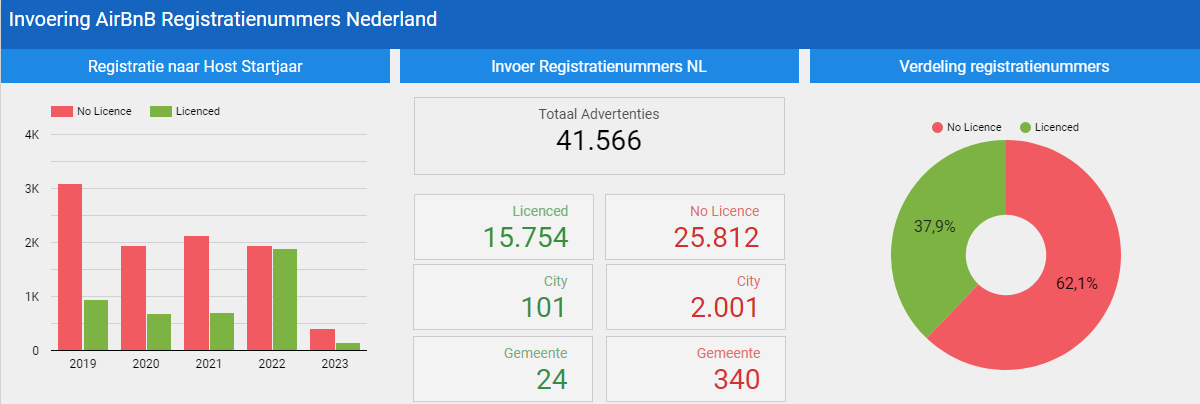
Airbnb Netherlands currently has more than 40,000 short-term rental listings, 37.9% of which have a registration number (as of May 2023). The number of registrations is clearly increasing, and for good reason: renting out your own home to tourists has become commonplace. For some, it is an enjoyable way to earn extra income, while others have made renting their primary occupation. Moreover, this is happening throughout the Netherlands. It is therefore no surprise that municipalities want to regulate rentals in areas where they cause nuisance.
Registration number as an instrument
The 2021 Tourist Rental of Residential Property Act gave municipalities instruments to regulate the unwanted side effects of short-term tourist rentals. One of these instruments is the registration number, which is linked to the citizen service number (BSN) and the official address identification (BAG ID) of the rental location. This gives municipalities insight into rental locations and enables them to establish rules, for example to determine whether social housing may be used for tourist rentals. If complaints from residents about nuisance in a particular neighbourhood increase, the municipality may also decide to stop issuing new registration numbers in that area.
Early adopters of the registration requirement include Amsterdam, The Hague, Rotterdam, Utrecht, Zaanstad, Gouda and Diemen. Haarlem, Zandvoort, Sluis, Leiden, Texel, Middelburg, Noordwijk, Maastricht, Naarden, Groningen and Noordwijkerhout followed in 2022. In 2023, Weesp joined following its integration with Amsterdam, as did the municipality of Delft. Airbnb is the largest short term rental provider in many municipalities, while its market share is considerably smaller in traditional holiday destinations such as coastal provinces.
Mandatory registration number
Is it necessary to fine hosts who do not include a registration number in their listings? Most cities prefer to first observe how implementation progresses during the initial period. However, we see that most municipalities introduce penalty clauses after approximately one year, because hosts might otherwise be inclined not to comply with the registration-number requirement. Following a six-month transition period — giving existing hosts time to update their listings — listings with registration numbers become visible.
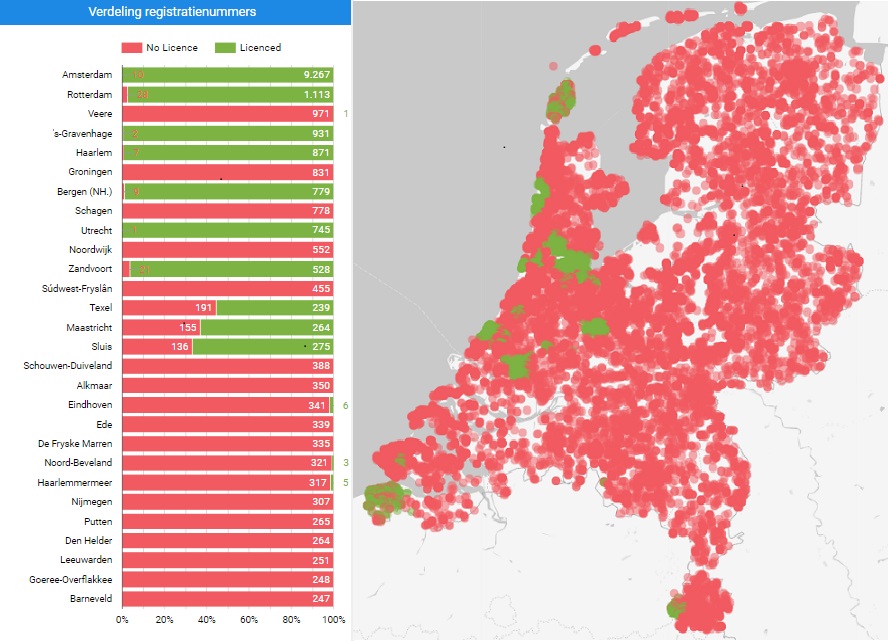
The figure below shows a list of municipalities and the number of Airbnb registrations. Municipalities highlighted in green have introduced mandatory registration numbers together with penalty clauses. Registration numbers became mandatory in Maastricht and Texel on 1 April, but Airbnb has not yet removed every listing without a registration number. Please note that listings from platforms such as Booking, VRBO, Expedia and TripAdvisor are not included in the figure, meaning the actual totals are higher.
Agreements with platforms
When a host receives a registration number from the municipality, this number must be included in the listing. Municipalities that make registration mandatory then contact various rental platforms directly to inform them that they may no longer display listings without a registration number or exemption within their jurisdiction. For example, after Amsterdam introduced its registration-number requirement, Airbnb removed 13,724 listings, representing 82% of its previous supply. Airbnb was not the only platform to remove listings after the tourist-rental legislation took effect; Booking.com did so as well. They are legally required to comply, as failure to do so is a criminal offence.
Platforms have created specific fields for publishing new listings. Their listing terms and conditions explicitly inform hosts or advertisers that they must comply with local tourism legislation. Advertisers enter the registration number or exemption themselves. In practice, we see that large international platforms such as Expedia, VRBO and TripAdvisor continue to publish listings without a registration number.
Incorrect use of the registration number
How is the registration number used in practice, and what do we observe? In most cases, the registration number is correctly stated in rental listings. However, incorrect use occurs in approximately 10% of cases:
- (1) An incorrect registration number is provided. Examples include using a telephone number, entering only zeros instead of the correct number, or supplying a random number.
- (2) One registration number is used for multiple locations. Different locations have different photographs, descriptions and titles, indicating deliberate misuse.
- (3) Hosts incorrectly believe they qualify for an exemption when they do not. Exemptions are defined differently in municipal housing regulations, causing confusion and resulting in incorrect exemption claims.
- (4) A notable exception involves companies targeting expats that use identical attractive photographs and the same registration number in different cities.
The number of available beds continues to grow
According to Statistics Netherlands (CBS), the number of guests staying in Dutch accommodation increased by 40% in 2022 compared with the previous year. Although no specific figures are available for private rentals, the collection of tourist tax from hosts is a reliable indicator. The website Gemeente.nu publishes the Atlas of Local Taxes by the University of Groningen (COELO), which concludes that tourist tax increased more strongly than any other local tax.
The figure below shows the growth in Airbnb bed capacity in the Netherlands over the years. There has been continuous growth since 2010, indicating that the tourist-rental supply is steadily increasing.
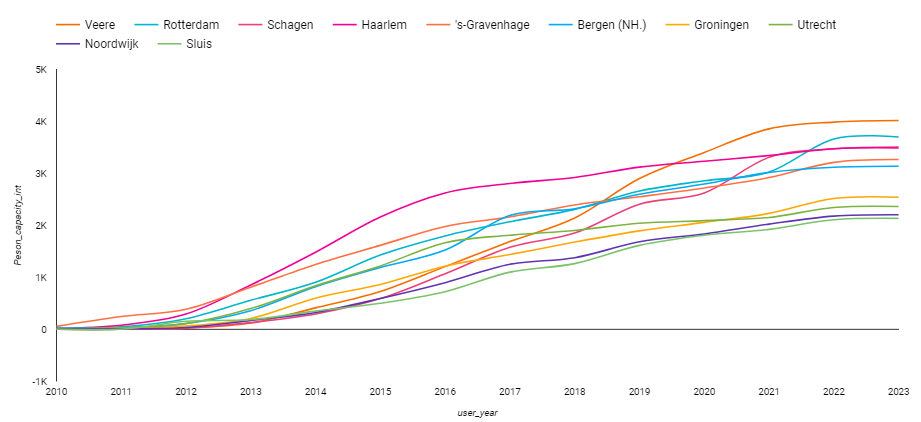
Note: this figure only shows beds that are currently available; beds that were previously offered but are no longer available are not included. The city of Amsterdam has been omitted from this figure.
Conclusion
Renting out a home to tourists has become commonplace, and the number of available beds continues to increase. To regulate short-stay holiday-home rentals effectively, more and more municipalities are introducing registration numbers and penalty clauses in their housing regulations. This should encourage hosts to comply with the rules. The first steps towards regulating tourist rentals have been taken. The municipalities experiencing the greatest problems now have a clearer picture of the issue, together with policy measures, regulatory instruments and enforcement tools.
Under European law, short-stay platforms must comply with local tourism regulations and therefore remove listings without a registration number when requested by a municipality. Comparing issued registration numbers with those displayed on rental websites remains the municipality’s responsibility, particularly in view of privacy legislation.